
موقع حكومي رسمي تابع لحكومة المملكة العربية السعودية


تنتهي روابط الموقع الرسمي للحكومة السعودية بـ gov.sa
جميع روابط المواقع التعليمية الرسمية في المملكة العربية السعودية تنتهي بـ sch.sa أو edu.sa

تستخدم المواقع الحكومية HTTPS بروتوكولًا للتشفير والأمان.
المواقع الآمنة في المملكة العربية السعودية تستخدم بروتوكول HTTPS للتشفير.




SDG 5.3.1 Measuring women’s application rate, acceptance/entry rate
 نُشِر في 2024-10-24
Updated 30/10/2025
5.3.1 Majmaah University’s Tracking of Women’s Application, Admission, and Completion Rates
Majmaah University (MU) demonstrates a clear commitment to gender equality in higher education, aligning with Sustainable Development Goal 5 (Gender Equality). In particular, the university systematically measures and reports women’s participation at all stages of the student lifecycle – from applications and admissions to study completion – and applies uniform academic criteria regardless of gender. All relevant policies, procedures, and statistics are transparently published through official channels (e.g. university website and student handbooks) to ensure clarity and accountability.
Tracking Female Application, Admission, and Completion Rates
Systematic Data Collection: Majmaah University, as an institution, actively tracks the number and proportion of female students at each critical stage – applications received, students admitted (entry), and students graduating. Internal statistics show that female students comprise nearly half of the university’s student body. For example, women constitute approximately 48% of total enrolled students at MU mu.edu.sa. This parity extends to outcomes: about 45% of all graduates in a recent academic year were female mu.edu.sa, indicating that women progress to completion at rates comparable to their enrollment. In fact, in the 2021–2022 academic year, female students slightly outnumbered males in overall graduation numbers – women accounted for 55.9% of total graduates (including undergraduate and graduate levels) m.mu.edu.sa. At the undergraduate (bachelor’s) level, women made up roughly 52% of graduates, and at the master’s level about 54.8%, demonstrating strong female completion rates across programs m.mu.edu.sa.
Numbers of Students
https://www.mu.edu.sa/sites/default/files/2024-01
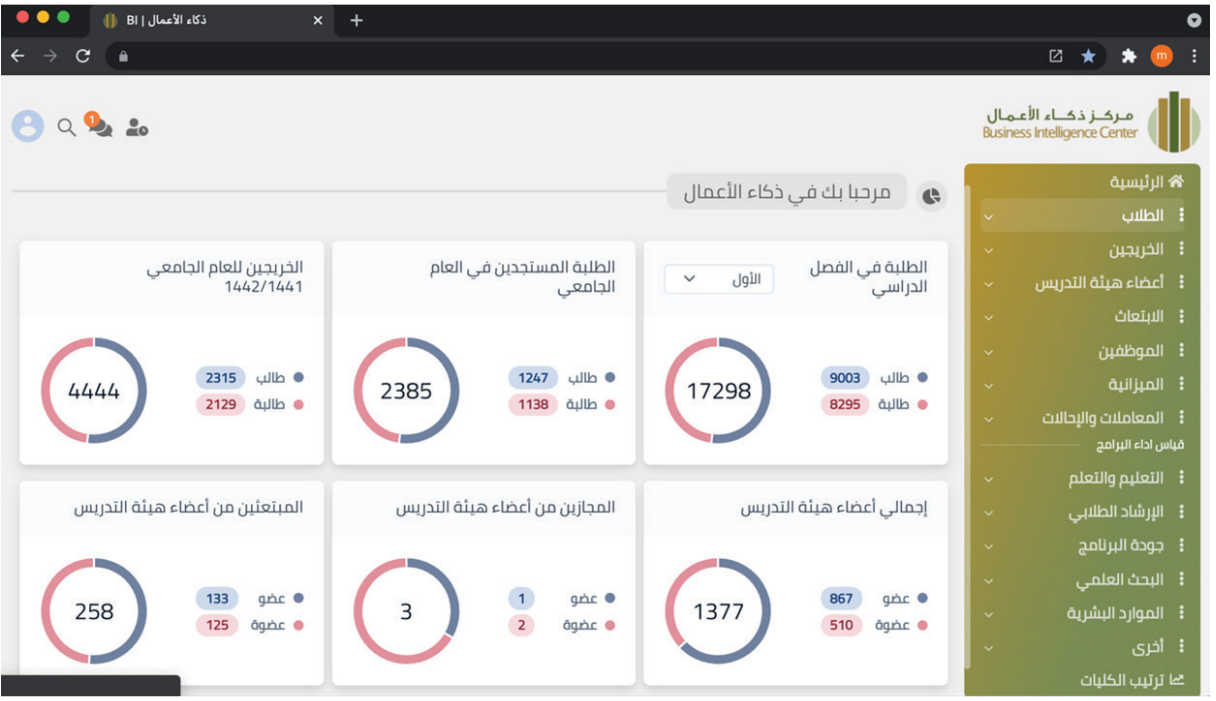
As shown in the above table, the number of male students are 2315 of the total students’ number which is 4444. So, the percentage of the male students is 52% and 48$ refers to the females.
The numbers show that female students are almost half of the university students.
(1/4/1) Total Number of Students (New – Enrolled – Graduates)
https://www.mu.edu.sa/sites/default/files/2024-01/
Table (1/1/4/1) shows the distribution of new students, enrolled students, and graduates at the university during the academic year 1443/1444 AH, categorized by academic status, nationality, and gender.
Table (1/1/4/1): Distribution of new students, enrolled students, and graduates at the university categorized by academic status, nationality, and gender during the academic year 1443/1444 AH.
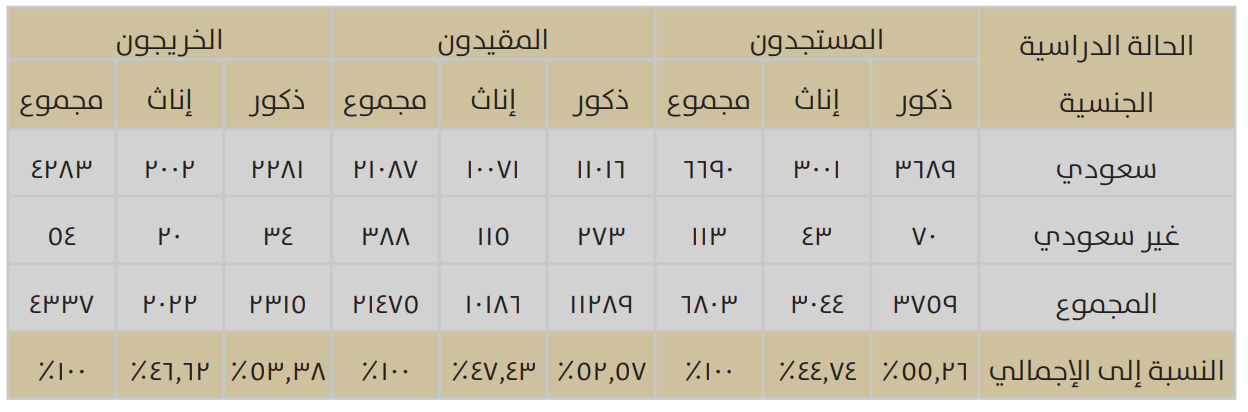
As shown in the above table, the number of graduated Saudi female students is 3001 of the total students’ number which is 6690. So, the percentage of the graduated female students is 45% and 55$ refers to the females.
On the other hand, the overall number of graduated female students is 3044 of the total students’ number which is 6803. So, the percentage of the graduated female students is 45%.
As a result, we notice that the percentage of the graduated female students is almost the half of the overall students’ number.
Figure (2/1/4/1): Percentages of new, enrolled, and graduate students at the university during the academic year 1443/1444 AH.
https://www.mu.edu.sa/sites/default/files/2024-01/
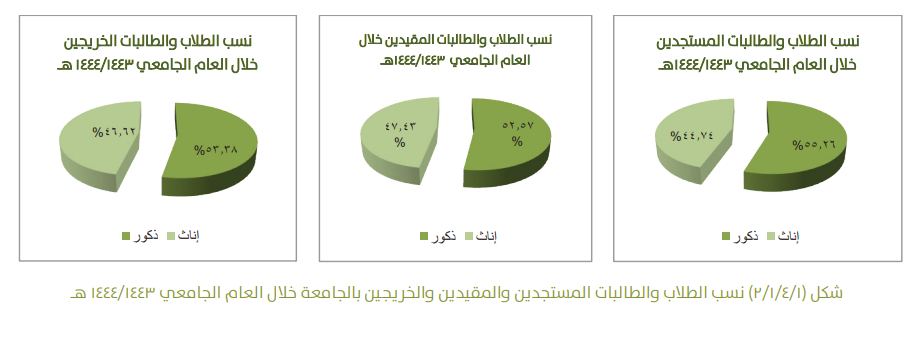
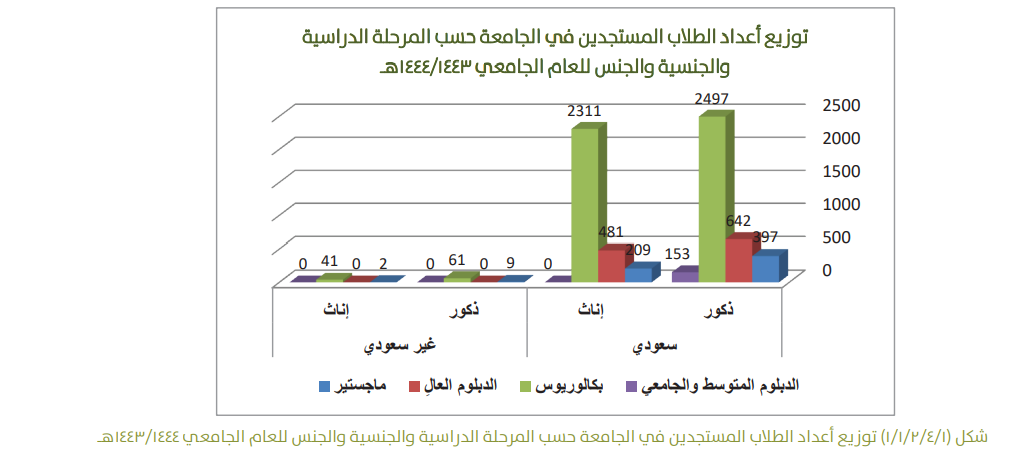
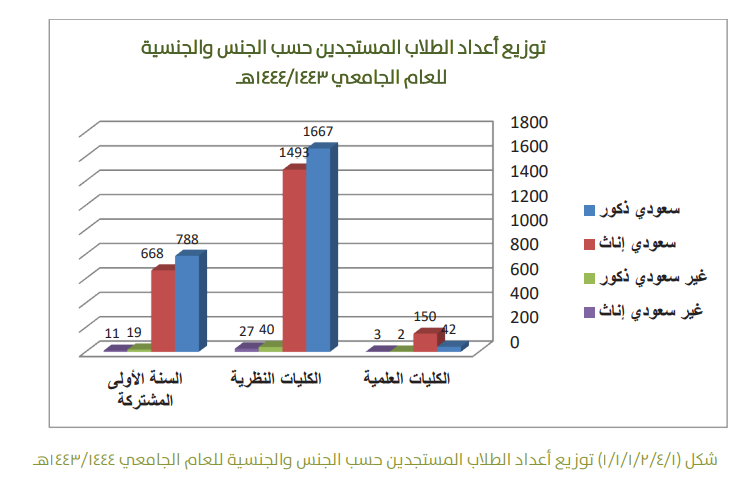
Figure (1/1/2/4/1): Distribution of the number of new students at the university by academic level, nationality, and gender for the academic year 1443/1444 AH.
https://www.mu.edu.sa/sites/default/files/2024-01/
https://www.mu.edu.sa/sites/default/files/2024-01/
Application and Admission Rates:
The university also monitors the gender breakdown of applicants and admitted students. Data from recent admissions cycles indicate that women form a majority of applicants and accepted students in many programs. For instance, one annual report noted that female applicants comprised ~77% of all undergraduate applications, and women represented about 80% of those ultimately admitted at the undergraduate level mu.edu.sa. Similarly, in postgraduate programs women made up roughly 72% of applicants. These figures illustrate that MU not only tracks these metrics but also achieves a high rate of women’s participation at entry. Such statistics are regularly collected and analyzed as part of MU’s performance indicators for SDG 5.3.1, which asks if the university measures women’s application, acceptance, and completion rates mu.edu.sa. The evidence from MU’s official SDG reports confirms an affirmative, data-driven approach to monitoring gender balance at each stage. Notably, female students at MU are nearly on par with male students in representation from intake through to graduation, reflecting the institution’s inclusive access and support.
Equal Admission and Completion Criteria for Both Genders
Unified Admissions Policy:
Majmaah University applies the same admission criteria and academic standards to all applicants and students, regardless of gender. The admissions process is described as “Unified Steps for All”, emphasizing that men and women follow identical procedures mu.edu.sa. According to the General Student Handbook (available on MU’s website), the Deanship of Admission & Registration is responsible for admitting new students based on transparent requirements and merit, with no separate standards by gender mu.edu.sa. Admission requirements explicitly use inclusive language (“the applicant…his/her high school certificate”) indicating that conditions apply equally to female and male candidates mu.edu.sa. For example, all applicants must hold a recognized secondary certificate, meet any specified grade or test criteria, be medically fit, and pass required exams or interviews – these conditions are gender-neutral and solely merit-based mu.edu.sa.
Identical Academic Standards:
Similarly, the criteria for academic progression and graduation are uniform for all students. University regulations state that “the student graduates after successfully completing the graduation requirements according to the study plan, provided that his cumulative average is not less than the rate determined…” m.mu.edu.sa. In practice, this means both women and men must achieve the same minimum academic performance (e.g. a minimum GPA of 2.0 out of 5.0, as per MU’s executive rule) to earn their degrees m.mu.edu.sa. There are no lower standards or different benchmarks set for one gender over the other; both are expected to fulfill identical coursework and grading requirements to graduate. This is reinforced by the fact that MU’s academic policies (published in student handbooks and the university’s regulations) make no distinction between male and female students when describing evaluation, continuation, or graduation rules. Both genders also have equal opportunities for academic support and are subject to the same examination and assessment procedures.
Policy Framework and Oversight:
MU’s governance ensures equal treatment through formal policy. The University Council approves the number of students admitted each year and oversees conditions, distributing male and female students across colleges based on their academic choices and capacity – not based on differing criteria mu.edu.sa. This means admission offers for women are made using the same cut-off scores and qualifications as for men, with the distribution to colleges simply ensuring that facilities (which may be gender-segregated per national norms) accommodate the admitted students. In summary, admissions and academic standards are unified: every student who meets the set requirements “finds a seat” at the university regardless of gender mu.edu.sa mu.edu.sa, and both genders must maintain the same performance levels to remain enrolled and to graduate.
Transparency of Criteria and Procedures
Majmaah University ensures that information on admission criteria, procedures, and related requirements is publicly and clearly available to all prospective students. The General Student Handbook – a comprehensive guide published online – outlines the conditions for admission, the steps of the application process, and academic policies in detail mu.edu.sa mu.edu.sa. This handbook (and related admission documents) is accessible on MU’s website, serving as a transparent reference for application conditions, required documents, timelines, and any entrance examinations. In it, the university “clarif[ies] the rules & regulations and increas[es] awareness of [their] application” mu.edu.sa, underscoring MU’s commitment to clear guidance. Key aspects such as minimum academic qualifications, required tests (e.g. aptitude or achievement tests), and interview policies are all explained in these public materials mu.edu.sa mu.edu.sa.
Procedures and Mechanisms: The application and admission mechanism is likewise transparent. MU employs a modern e-admission system where all applicants (male and female alike) register and submit their preferences online mu.edu.sa. The process – from filling out the online form to receiving an admission offer – is described step-by-step on the university portal and in admission announcements. For instance, after applications are collected, students are admitted based on who has met all requisites, using an “equivalent average” (weighted score) and their college choice, and results are communicated via email/SMS mu.edu.sa. This merit-based selection method is clearly stated so applicants understand how admissions decisions are made. Additionally, the fee structure (if any applicable tuition or entrance fees) is made available through official channels such as the Admissions Deanship site and acceptance letters. (Note: As a public Saudi university, MU generally does not charge tuition for local undergraduate students, which means there may be no “entrance fee” for most entrants. Any special program fees or continuing education diploma fees are published alongside those program announcements.)
Student Guidance and Support: Beyond published documents, MU provides guidance through its Deanship of Admission & Registration. The Deanship’s mission includes “simplifying procedures” and ensuring applicants are well-informed mu.edu.sa. The university regularly issues news bulletins and dedicated web pages during the admission period to remind applicants of conditions and deadlines. For example, news updates from the Dean of Admission have highlighted the ease of the online application process and even announced extensions of application deadlines to accommodate more candidates mu.edu.sa mu.edu.sa. Separate application links for male and female applicants are provided (to streamline campus-specific processing), but the content of the application and requirements is identical. All such information – from criteria to procedural updates – is disseminated openly via MU’s official website and its social media, ensuring transparency.
Furthermore, MU publishes student handbooks and catalogs that contain academic regulations (such as grading policies, graduation requirements, and support services) which apply equally to both genders. These documents are often available in both Arabic and English, increasing accessibility. The clarity of these publications is evidenced by MU’s own evaluation; the university strives to “provide adequate academic information about the university [and] specializations” to prospective students mu.edu.sa. In summary, any student (or stakeholder) can readily find the admission conditions, processes, and completion requirements on MU’s platforms, reflecting a high level of transparency and fairness in how this information is shared.
Gender-Disaggregated Statistical Reporting
To track progress on gender equity, Majmaah University has instituted robust gender-disaggregated reporting practices. The university’s institutional research and ranking departments regularly compile data split by gender for key indicators such as enrollment, graduation, and even academic performance. These statistics are often published in annual reports and on the official website. Notably, MU’s “University Statistics” webpage highlights overall numbers of enrolled and graduating students, and these figures are broken down by gender in detailed tables mu.edu.sa mu.edu.sa. For example, internal tables for 1443–1444 AH (2022–2023) show new student intakes, total enrolled students, and graduates categorized by gender (male vs female) and nationality mu.edu.sa. The data indicated that female students were roughly 48% of total enrollment and 45% of graduates that year mu.edu.sa mu.edu.sa, information which is publicly accessible on the MU site.
In line with Times Higher Education (THE) Impact Rankings reporting requirements, MU has a dedicated section for SDG 5 (Gender Equality) where it addresses metrics like 5.3.1 (women’s application, acceptance, completion rates) and 5.5 (gender mix of admissions). The university’s SDG 5.3.1 report explicitly answers that it does track these rates, providing the data as evidence mu.edu.sa mu.edu.sa. Likewise, under SDG 5.6.7 (tracking women’s likelihood of graduating vs men’s), MU publishes the percentage of female graduates at each degree level, as seen in 2021–2022 stats m.mu.edu.sa. This practice of gender-disaggregated monitoring enables MU to identify any gaps and ensure women are not underrepresented at later stages of study. The figures so far illustrate that women at Majmaah University have graduation rates on par with or even exceeding those of men, which the university proudly reports as part of its Impact Rankings submission.
Moreover, MU’s commitment to open data is evident through its Open Data initiative on the university portal, where visitors can find key statistics and datasets (including gender-based data) for public use. While much of the gender data is summarized in reports and infographics, the availability of such information demonstrates transparency. The Deanship of Development and Quality and the Ranking Department at MU ensure that data on female student enrollment and success are regularly updated and included in institutional performance reports. By making these figures available, MU holds itself accountable to stakeholders and highlights progress toward gender equity goals.
Majmaah University’s approach to women’s applications, admissions, and completions is comprehensive and transparent. The university systematically tracks female student metrics at each stage and the data confirms a healthy gender balance – women are applying in large numbers, being admitted at equal (if not higher) rates, and completing their studies successfully. Crucially, MU enforces a single, merit-based admissions policy and identical academic standards for all students, male or female, ensuring fairness in opportunity and outcome. All relevant criteria, conditions, procedures (and any applicable fees) are clearly published in official guides and online platforms, so applicants and students fully understand the process. The university’s regular publication of gender-disaggregated statistics and its inclusion of these indicators in sustainability reports (e.g. THE Impact Rankings submissions) further demonstrate an institutional culture of accountability and continuous improvement in gender equality. Overall, Majmaah University exemplifies best practices in providing equal access to education and in openly reporting on its performance toward closing any gender gaps in higher education participation mu.edu.sa m.mu.edu.sa.

شارك برأيك وساهم في تحسين خدماتنا.
أعجب 0 من 168 زائر بمحتوى الصفحة. (0% مؤشر رضا الزوار)