
موقع حكومي رسمي تابع لحكومة المملكة العربية السعودية


تنتهي روابط الموقع الرسمي للحكومة السعودية بـ gov.sa
جميع روابط المواقع التعليمية الرسمية في المملكة العربية السعودية تنتهي بـ sch.sa أو edu.sa

تستخدم المواقع الحكومية HTTPS بروتوكولًا للتشفير والأمان.
المواقع الآمنة في المملكة العربية السعودية تستخدم بروتوكول HTTPS للتشفير.



Education for SDGs in the wider community SDG 17.4.2
 نُشِر في 2024-10-29
Updated 30/10/2025
17.4.2
Majmaah University’s Sustainability-Focused Academics (2022–2025)
Integration of Sustainability in the Curriculum
Majmaah University (MU) has made a strong commitment to sustainability education in recent years, aligning its curriculum with environmental stewardship and the UN Sustainable Development Goals (SDGs) mu.edu.sa. This commitment is reflected in new degree programs and courses (launched or updated between 2022 and 2025) that equip students with knowledge and skills to address environmental challenges and promote sustainable development. Across multiple colleges – from Sciences and Engineering to Education and Business – MU has embedded sustainability principles and SDG-related content into its academic offerings. Below we outline the key degree programs and courses focused on sustainability, the departments offering them, and how they align with SDG themes.
Sustainability-Focused Degree Programs in Science and Engineering
-
B.Sc. Environmental Technology (College of Science):
In 2023, MU introduced an Environmental Technology undergraduate program (also referred to as Environment Protection Technology) with a comprehensive curriculum on environmental issues and sustainable practices mu.edu.sa. This program trains students in topics like pollution control, ecosystem management, and sustainability strategies, preparing graduates to tackle pressing environmental challenges mu.edu.sa. (A study plan for the Environment Protection Technology program was published in 2023, indicating its recent launch.) The College of Science also integrates environmental content into other science degrees – for example, the Biology B.Sc. program includes courses such as Environmental Pollution, Biodiversity, Ecophysiology, and Medicinal & Economical Plants, giving students a solid grounding in ecology, conservation, and the impact of human activities on natural systems mu.edu.sa. These courses cultivate understanding of issues like biodiversity loss and pollution, directly supporting SDG goals on Life on Land and Climate Action.
Sustainable Courses
Majmaah University integrates environmental education into its academic curriculum as part of its strong commitment to sustainability and the United Nations Sustainable Development Goals (SDGs). By offering a range of environmental courses across disciplines—such as environmental technology, pollution control, biodiversity, and environmental engineering—the university ensures that students are equipped with the knowledge and skills needed to understand and address pressing environmental challenges. These courses not only enhance students’ scientific and technical competencies but also foster a sense of environmental responsibility and stewardship. Incorporating environmental education into the curriculum is a vital step in cultivating a sustainability-minded generation, capable of driving positive change within their communities and contributing to Saudi Arabia’s Vision 2030 goals for sustainable development.
Environmental Courses at Majmaah University
1. College of Sciences
Environmental Technology Program: This program provides a comprehensive curriculum focusing on environmental issues and sustainable practices. It aims to equip students with the knowledge and skills necessary to address environmental challenges.
Biology Program: Within this program, students can enroll in courses such as:
· Environmental Pollution
· Biodiversity
· Ecophysiology
· Medicinal & Economical Plants
These courses delve into various aspects of environmental science, offering students a deeper understanding of ecological systems and conservation efforts.
-
M.Sc. Renewable Energy Engineering (College of Engineering):
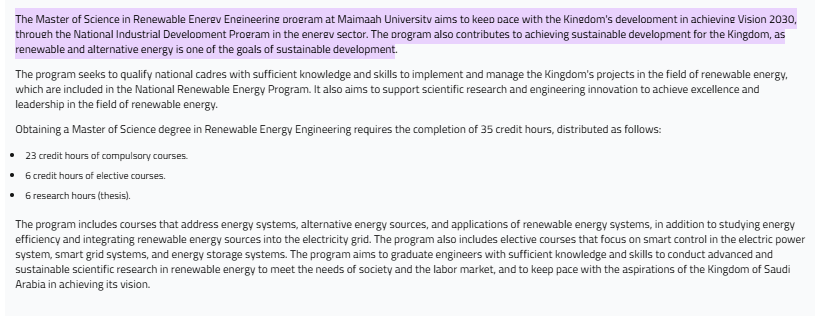
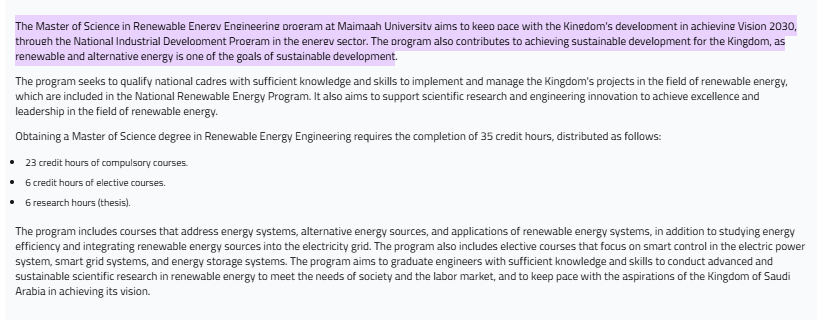
At the graduate level, MU launched a Master of Science in Renewable Energy Engineering (approx. 2021, with intakes continuing through 2025) to advance the Kingdom’s clean energy goals. This 35-credit program (taught in English, 2-year duration) was created in line with Saudi Vision 2030 and explicitly contributes to the UN SDGs, noting that renewable and alternative energy development is “one of the goals of sustainable development.” mu.edu.sa. The curriculum covers renewable energy sources (solar, wind, hydro), energy efficiency, energy storage, and integration of renewables into power grids mu.edu.sa. Students complete core courses (e.g. on energy systems and alternative energy technologies), electives on smart grids or energy storage, and a research thesis mu.edu.sa. By training specialists in clean energy, the program aligns closely with SDG 7 (Affordable and Clean Energy) and climate action objectives. MU’s description of the program emphasizes its role in producing experts who can implement sustainable energy projects and drive innovation in renewable technologies mu.edu.sa mu.edu.sa. As of 2025, admission to this M.Sc. remains active and supports national efforts in sustainable industrial development and GHG emission reduction.
Master of Science in Renewable Energy Engineering
-
Civil & Environmental Engineering (College of Engineering):
MU’s Department of Civil and Environmental Engineering integrates sustainability into its undergraduate engineering curriculum. The B.Sc. in Civil Engineering includes dedicated courses in environmental engineering and resource management. For instance, by 2024 the department offered specialized courses such as CE 360 – Environmental Engineering, CE 362 – Water and Wastewater Treatment, CE 498 – Environmental Engineering Design, and CE 499 – Environmental Engineering Project mu.edu.sa. These courses (supported by an Environmental Engineering laboratory for hands-on experience) teach engineering students about water quality, pollution control, waste treatment, and designing infrastructure with minimal environmental impact mu.edu.sa. The inclusion of this suite of courses ensures that future engineers are versed in sustainable design and environmental protection practices (advancing SDG 6: Clean Water and Sanitation and SDG 11: Sustainable Cities). The Civil & Environmental Engineering track has been a part of the college’s offerings and was reinforced in the 2022–2025 period as MU documented its environmental engineering curriculum as evidence of SDG education mu.edu.sa.
Sustainable Courses
Majmaah University integrates environmental education into its academic curriculum as part of its strong commitment to sustainability and the United Nations Sustainable Development Goals (SDGs). By offering a range of environmental courses across disciplines—such as environmental technology, pollution control, biodiversity, and environmental engineering—the university ensures that students are equipped with the knowledge and skills needed to understand and address pressing environmental challenges. These courses not only enhance students’ scientific and technical competencies but also foster a sense of environmental responsibility and stewardship. Incorporating environmental education into the curriculum is a vital step in cultivating a sustainability-minded generation, capable of driving positive change within their communities and contributing to Saudi Arabia’s Vision 2030 goals for sustainable development.
Environmental Courses at Majmaah University
2. College of Engineering
Civil and Environmental Engineering Department: The department offers specialized courses in environmental engineering, including:
· CE 360 – Environmental Engineering
· CE 362 – Water and Wastewater Treatment
· CE 498 – Environmental Engineering Design
· CE 499 – Environmental Engineering Project
These courses are supported by the Environmental Engineering Laboratory, which provides hands-on experience with equipment such as pH meters, turbidity meters, and spectrophotometers.
-
Mechanical Engineering – Renewable Energy Component:
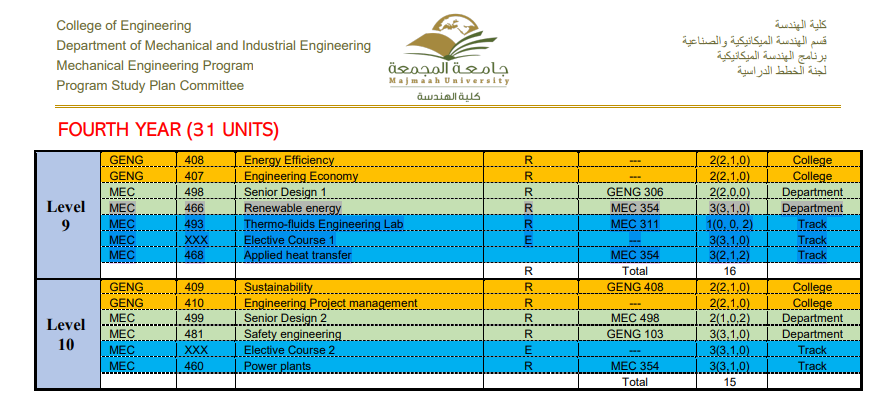
Sustainability concepts have also been woven into core Mechanical Engineering education. In 2024, the College of Engineering updated the B.Sc. Mechanical Engineering curriculum to incorporate renewable energy. A new required course, MEC 466: Renewable Energy, was added, covering renewable energy technologies and their applications mu.edu.sa. By including MEC 466 as a compulsory course, MU ensures all mechanical engineering students gain exposure to sustainable energy principles and green technology (reinforcing the interdisciplinary approach to SDGs). This change, effective in the 2024–2025 curriculum, reflects MU’s effort to integrate climate action and clean energy topics into undergraduate engineering training.
Sustainability-Themed Courses Across Disciplines
Beyond dedicated environment programs, Majmaah University has infused sustainability and SDG topics into various disciplines’ coursework, illustrating a broad-based educational approach:
-
Science and Environmental Studies:
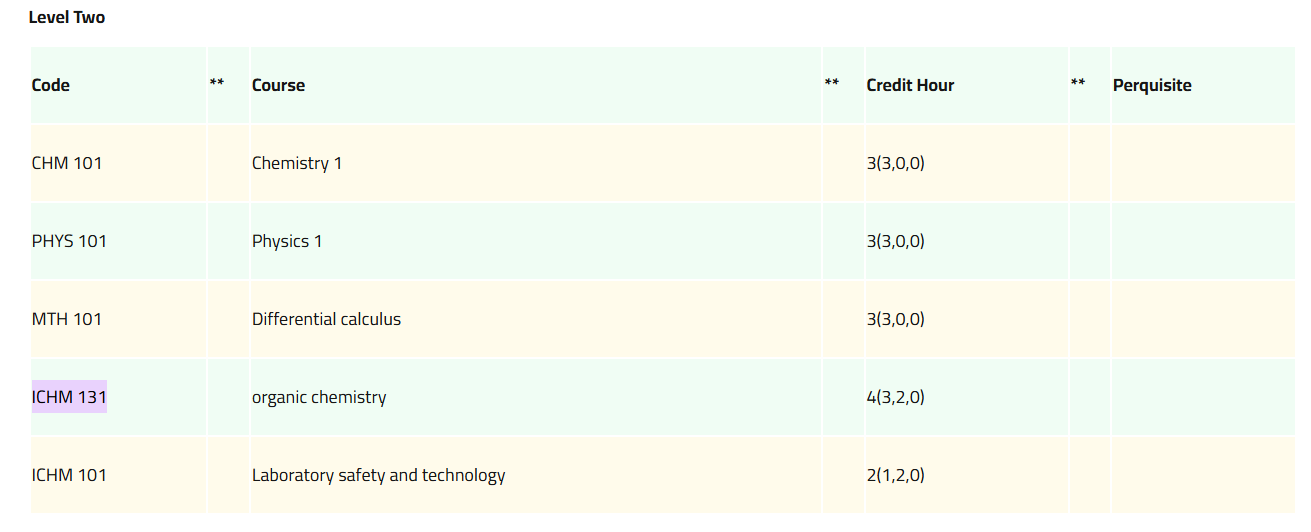
In addition to the Environmental Technology program mentioned earlier, MU’s science curricula address sustainability through elective and required courses. The Biology department’s offerings on Environmental Pollution and Biodiversity, for example, educate science majors on ecosystem health, conservation, and human impacts on the environment mu.edu.sa. These courses (available through 2022–2025 and beyond) directly relate to global sustainability issues such as pollution mitigation, wildlife conservation, and medicinal plant use, thereby linking to SDGs like Life Below Water (SDG 14) and Life on Land (SDG 15). MU has highlighted that it “offers educational programs and courses that promote sustainability, environmental science, and conservation” as part of its contribution to SDGs mu.edu.sa. Similarly, the Industrial Chemistry program (College of Science) updated in 2023 includes practical training in materials and safety (e.g. Laboratory Safety and Technology, polymer chemistry, etc. m.mu.edu.sa m.mu.edu.sa), which can be tied to sustainable industrial practices and responsible chemical management (supporting SDG 12: Responsible Consumption and Production).
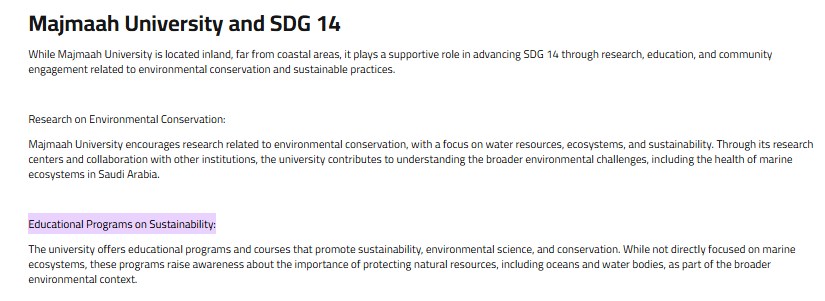
Study plan for industrial chemistry program
-
Education and Humanities (College of Education):
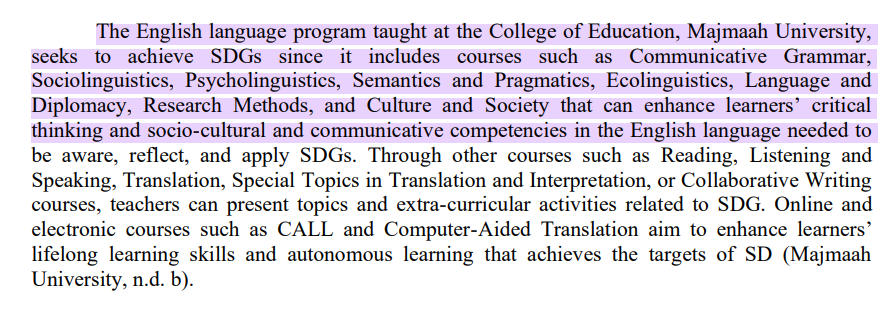
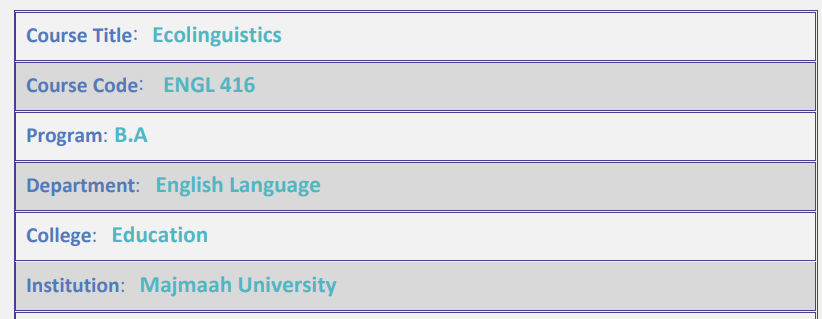
Sustainability education at MU is not limited to the natural sciences – it extends into the humanities and teacher training. Notably, the English Language B.A. program (College of Education) has incorporated SDG themes into its curriculum. A standout example is the course ENGL 416: Ecolinguistics, which examines the relationship between language and the environment files.eric.ed.gov. Introduced and revised by 2023, this course exposes students to concepts of how language reflects and influences ecological thought, covering topics like climate change discourse, biodiversity loss, and environmental justice in communication mu.edu.sa mu.edu.sa. Through Ecolinguistics and related content, English majors engage with sustainability issues from a linguistic and cultural perspective, developing “critical thinking and socio-cultural competencies… needed to be aware, reflect, and apply SDGs” in their future careers files.eric.ed.gov. Other courses in the English program (e.g. Language and Diplomacy, Culture and Society, Translation courses) are leveraged to discuss sustainable development topics and global citizenship, illustrating MU’s cross-disciplinary approach to SDG 4 (Quality Education) files.eric.ed.gov. This integration in the College of Education helps future educators and graduates infuse sustainability awareness in various fields.
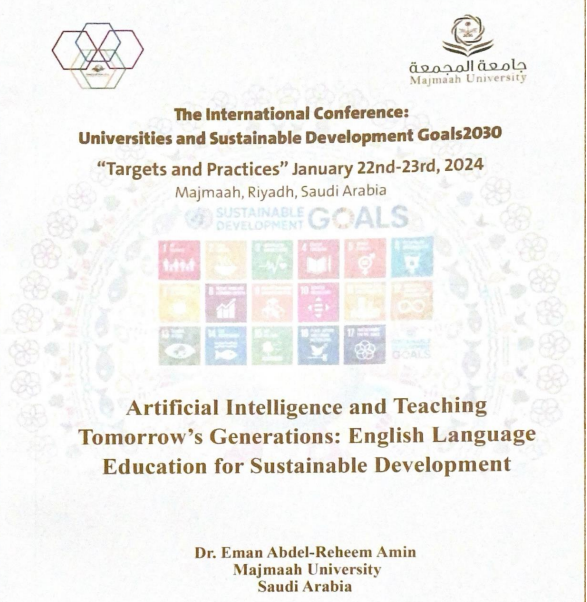
Eco linguistics
-
Business and Social Responsibility (College of Business Administration):
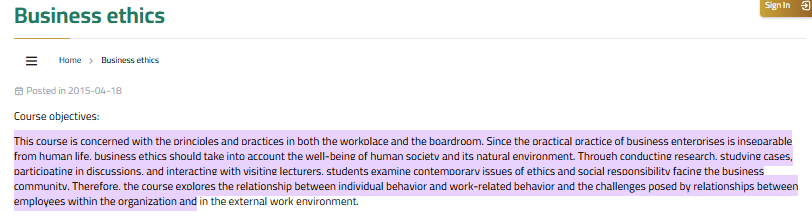
MU also embeds sustainability principles in business and management education. For instance, the “Business Ethics” course in the College of Business (part of the Business Administration program) explicitly connects ethical business practice with social and environmental responsibility. The course (offered since the 2010s and continuing in the curriculum) teaches that business decisions must consider “the well-being of human society and its natural environment.” Students study corporate social responsibility (CSR), ethical case studies, and stakeholder impacts on communities and ecology mu.edu.sa. Through research projects and discussions, Business Ethics fosters understanding of sustainable corporate behavior and ethical leadership in line with SDG 12 (Responsible Consumption/Production) and SDG 8 (Decent Work and Economic Growth). MU’s emphasis on ethics and CSR in business curricula ensures that graduates in finance and management are cognizant of sustainability challenges and the role of business in achieving the SDGs.
-
Public Health and Other Fields:
While Majmaah University does not have a standalone degree in “sustainable public health,” elements of sustainability appear in health and safety contexts as well. The university’s Department of Occupational and Environmental Health (an administrative unit) conducts campus initiatives on environmental health and waste management, and MU engages health sciences students in community outreach related to topics like medical waste disposal and water conservation mu.edu.sa mu.edu.sa. These efforts complement the formal curriculum by illustrating applied sustainability practices (e.g. proper waste segregation aligns with SDG 3 and SDG 12, ensuring healthy lives and responsible waste management). In general, MU encourages interdisciplinary learning where future professionals in all fields—engineering, science, education, business, and health—gain some exposure to sustainable development concepts, either through coursework or co-curricular activities.
Temporary Storage Requirements for Medical Waste
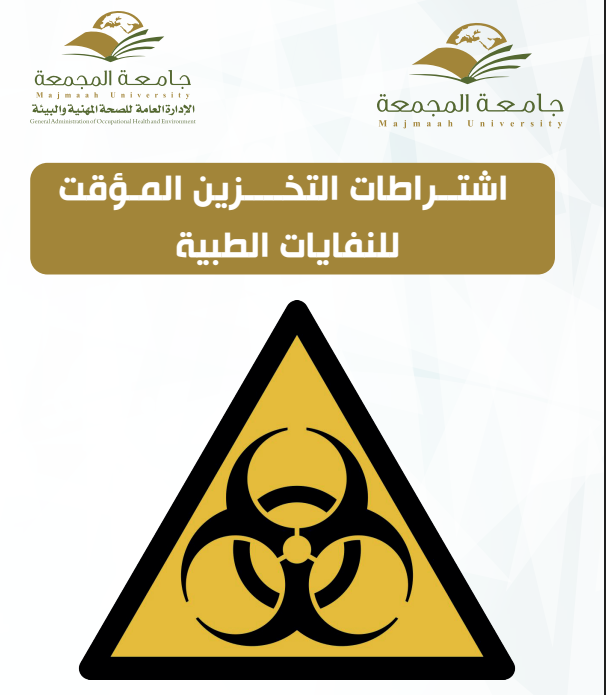
Any healthcare facility that wishes to temporarily store hazardous healthcare waste within the facility until it is transported to a treatment unit must follow the conditions outlined below:
· A designated storage area must be provided within the healthcare facility to serve as a collection center for hazardous healthcare waste generated by the facility.
· Waste must be packaged in containers or bags before storage.
· The storage location must be appropriate, ensuring that it does not cause any pollution or harm to human health and the environment.
· The storage area should be well-sealed, protected from water leakage, rain, unpleasant odors, and the entry of rodents, insects, birds, and stray animals. It must have a solid, washable, and disinfectable floor with adequate drainage.
· The storage area must be equipped with fire safety and protective equipment.
· The storage area should be managed by specialists in hazardous healthcare waste management.
· The storage site must have proper air conditioning, adequate lighting, and ventilation, with a temperature maintained between 15-18°C.
· Hazardous healthcare waste must not be stored for more than 24 hours.
· The storage site should be easily accessible for storage, transportation, and cleaning purposes.
· The storage site must be far from food storage areas, kitchens, and food preparation places, and away from patient care areas.
· Only authorized personnel are allowed to access the storage site.
· Clear signs must be posted at the storage site to indicate its contents.
· The site must be equipped with a running water source, a handwashing sink, appropriate cleaning tools, and disinfectants for continuous cleaning, emergencies, and in the event of waste spills.
· The storage site should have proper air conditioning, adequate lighting, and ventilation, with a temperature maintained between 15-18°C.
· An emergency plan must be in place to handle waste spills.
Alignment with the UN SDGs and Vision 2030
Majmaah University’s academic offerings from 2022 to 2025 show clear alignment with the United Nations SDGs in both content and intended outcomes. Many programs explicitly reference national and global sustainability goals. For example, the Renewable Energy M.Sc. program is described as supporting Saudi Vision 2030 and “achieving sustainable development for the Kingdom,” directly tying into SDG 7 (clean energy) and climate action targets mu.edu.sa. Likewise, course materials often link to SDG themes: the Ecolinguistics course discusses climate change, biodiversity, and environmental justice – all central issues of the SDG agenda mu.edu.sa mu.edu.sa. MU’s impact monitoring documents note that the university provides education around SDG 13 (Climate Action) by offering programs on environmental science and climate change that raise student awareness mu.edu.sa. They also highlight courses emphasizing SDG 12 (Responsible Consumption & Production), teaching students about sustainable consumption, waste reduction, and resource stewardship mu.edu.sa.
Master of Science in Renewable Energy Engineering
Eco linguistics
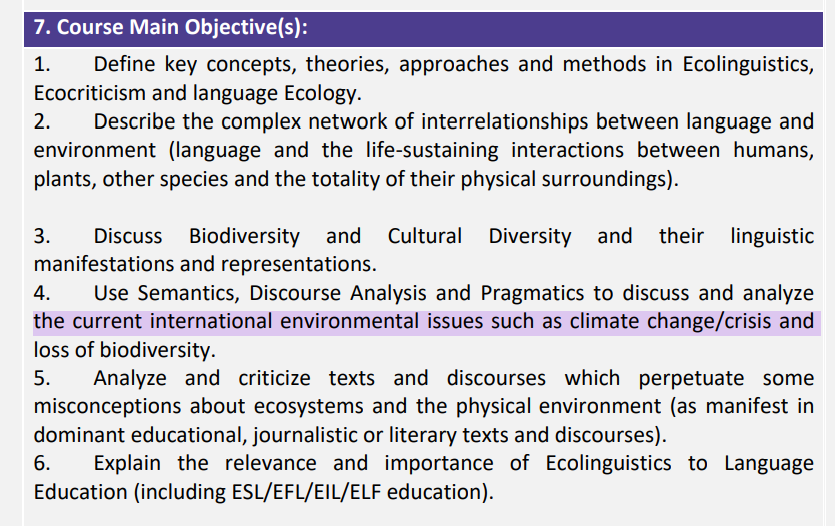
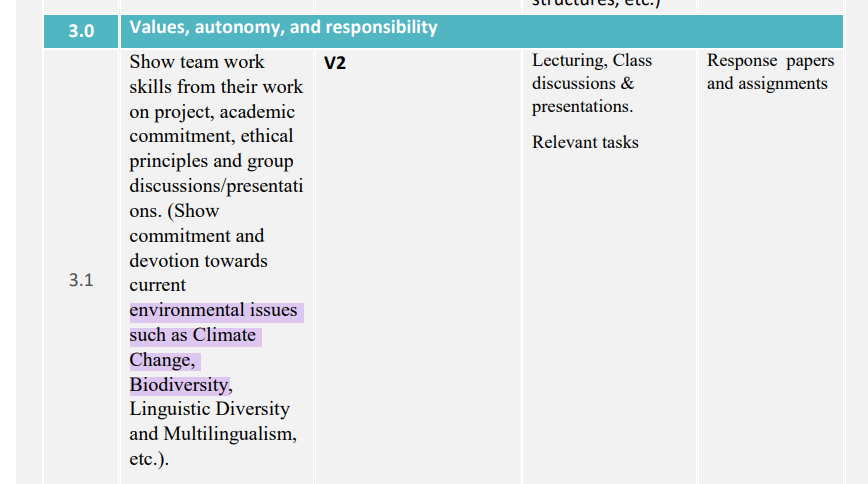
Importantly, MU integrates the SDGs not just as abstract concepts but through practical learning outcomes. Engineering students undertake projects on water treatment and pollution control (addressing real-world SDG challenges in clean water and ecosystems), and business students evaluate ethical scenarios that mirror SDG-related dilemmas (like environmental sustainability vs. profit). The College of Education’s mission explicitly includes promoting the principles of the UN 2030 Agenda, partly in partnership with initiatives like CIFAL Saudi on campus m.mu.edu.sa m.mu.edu.sa. (CIFAL Saudi at MU, established with UNITAR, provides training and professional courses on the SDGs to students and local officials, reinforcing the university’s role in SDG education beyond the classroom m.mu.edu.sa m.mu.edu.sa.) Through these multifaceted efforts, Majmaah University ensures that sustainability is a recurring theme across disciplines. By 2025, MU has cultivated an academic environment where learning about climate action, renewable energy, environmental management, and social responsibility is part of the student experience in many programs. This holistic integration of sustainability education demonstrates MU’s contribution to the UN SDGs – preparing graduates who are knowledgeable about sustainable development and capable of advancing these goals in their future careers and communities mu.edu.sa files.eric.ed.gov.
CIFAL Saudi Arabia Center at Majmaah University
https://www.mu.edu.sa/en/centers-and-institutes/cifal-center-2
Established in collaboration with UNITAR, the CIFAL Saudi Arabia Center focuses on training activities related to economic development, social inclusion, and environmental sustainability. The center aims to enhance the capacities of public servants and leaders in Saudi Arabia by offering learning opportunities that promote sustainable development and social inclusion.
CIFAL Saudi Arabia's objective is to provide a range of learning opportunities and facilitate knowledge sharing between public servants and leaders of the Kingdom of Saudi Arabia, to strengthen capacities, improve the decision-making process and encourage sustainable development.
The CIFAL Global Network is under the UNITAR and composed of 34 International Training Centres for Authorities and Leaders. The strategic locations of the 34 centres, which can be found across Asia, Oceania, Africa, Europe and the Americas ensure a global outreach. Each CIFAL centre provides innovative training and serves as a hub for the exchange of knowledge amongst government officials, the private sector, and civil society.
It provides a platform for dialogue and knowledge transfer on key development-related issues.
Over the past five years, CIFAL Global network reached approximately 50000 beneficiaries through 500 learning. events.
Vision:
To excel in creating a sustainable society and a prosperous economy.
Mission:
The Cifal Center strives to create a sustainable society and a prosperous economy by building the capacities of all individuals and entities in society. This is achieved through training opportunities and providing enablers for the exchange of practices, tools and strategies among different sectors locally and internationally to contribute to achieving the United Nations Sustainable Development Goals 2030.
Goals:
1. Promote understanding of (SDGs)
To conduct training programs and workshops to increase awareness and understanding of the 17 Sustainable Development Goals and how to achieve them.
2. Build local and regional capacities
To develop the skills of professionals, policy makers and community leaders to develop their capacities at the local and regional levels.
3. Strengthen strategic partnerships
To encourage cooperation between government, private and international sectors and civil society organizations to achieve the SDGs.
4. Exchange of knowledge and good practices
To create a platform for the exchange of knowledge, experiences and good practices in areas such as sustainable urban management, climate change and poverty reduction.
5. Support innovation and technology
To encourage the use of technology and innovation as tools to accelerate progress towards sustainable development.
6. Raise awareness of global and local challenges
To boost awareness of global challenges such as climate change and poverty, and how local interventions can contribute to solving these challenges.
7. Working with United Nations organizations:
The Saudi Cifal Center provides unique access to global resources and expertise through its global network and affiliation with the United Nations Institute for Training and Research, enhancing its ability to conduct advanced training programs in line with the latest international standards and practices.
8. Specialized local expertise:
The Saudi Cifal Center has a deep understanding of the local context and challenges, enabling it to design training programs specifically to meet the needs of the Kingdom of Saudi Arabia and achieve maximum impact in the areas of sustainable development, management and innovation.
9. Focus on sustainable development:
The Saudi Cifal Center’s commitment to supporting and promoting the United Nations Sustainable Development Goals is a unique factor, allowing the Center to seek to integrate these goals into all its training programs and consulting projects.
10. Strategic partnerships:
The Saudi Cifal Center is proud of its extensive network of partnerships with government agencies, international organizations, private sector, and civil society organizations, which expands its scope of influence and enhances its ability to provide comprehensive and innovative training solutions.
11. Innovation in training:
The center relies on innovative training methods that include the use of modern technology and interactive and experiential learning methods, making the learning experience more effective and attractive for participants.
12. Excellence in quality and performance:
The Saudi Cifal Center is committed to the highest quality standards in conducting training programs, through periodic evaluation and review processes that ensure continuous improvement and development of training content and methods.
13. Tangible and measurable impact:
The center focuses on achieving measurable results with a lasting impact, as training programs are designed not only to transfer knowledge, but to stimulate positive change and enhance individual and institutional capabilities.
14. Flexibility and adaptability:
The Saudi Cifal Center is well-known for its ability to adapt to new changes and challenges, allowing it to provide updated training solutions that respond to the evolving needs of beneficiaries.

شارك برأيك وساهم في تحسين خدماتنا.
أعجب 0 من 149 زائر بمحتوى الصفحة. (0% مؤشر رضا الزوار)