
موقع حكومي رسمي تابع لحكومة المملكة العربية السعودية


تنتهي روابط الموقع الرسمي للحكومة السعودية بـ gov.sa
جميع روابط المواقع التعليمية الرسمية في المملكة العربية السعودية تنتهي بـ sch.sa أو edu.sa

تستخدم المواقع الحكومية HTTPS بروتوكولًا للتشفير والأمان.
المواقع الآمنة في المملكة العربية السعودية تستخدم بروتوكول HTTPS للتشفير.




SDG 4.3.5Policy that ensures that access to all activities is accessible to all
 نُشِر في 2024-10-24
Updated 30/10/2025
4.3.5 Majmaah University’s Policy on Equal Access and Non-Discrimination
Inclusive and Non-Discriminatory Policy
Yes, Majmaah University (MU) has a formal policy ensuring equal access for all individuals in its community, regardless of ethnicity, religion, disability, gender, or other characteristics. This policy is articulated in the university’s “Policy Statement on Students' Rights and Responsibilities,” which explicitly states that “Majmaah University does not discriminate or permit discrimination by any member of its community against any individual on the basis of race, color, religion, national origin, gender identity, parental status, marital status, age, disability, citizenship, or genetic information” in all areas including admissions, employment, services, educational programs, and activities mu.edu.sa. In practice, this means MU rejects all forms of discrimination and requires that all students, staff, and faculty be treated equitably. The university adheres to Saudi Arabian laws banning discrimination in higher education and prohibits discrimination against any student or employee on the basis of any protected class, covering characteristics such as age, ethnicity, disability, race, color, creed, marital status, etc. This non-discrimination policy applies both to educational opportunities and employment practices at MU mu.edu.sa. In short, the institution guarantees that no one is denied access to university activities or benefits due to their personal background or identity.
Policy Statement on Students' Rights and Responsibilities
https://www.mu.edu.sa/sites/default/files/content/2020/10/General%20Student%20Handbook.pdf
At Majmaah University, life outside the classroom is an integral part of the educational process. The exercise of responsibility is an important part of the development of the full potential of the student as an individual and as a citizen. The student’s awareness of the extent of his or her rights and responsibilities is necessary to the exercise of responsibility within the University community. To further these objectives and in recognition of students as members of the Majmaah University community, the University has adopted the following statement of policy.
a. Majmaah University does not discriminate or permit discrimination by any member of its community against any individual on the basis of race, color, religion, national origin, gender identity, parental status, marital status, age, disability, citizenship, or genetic information in matters of admissions, employment, services or in the educational programs or other activities.
b. The student has freedom of research, of legitimate classroom discussion, and of the advocacy of alternative opinions to those presented in the classroom.
c. The student will be evaluated on the basis of knowledge and academic performance for purposes of granting academic credit and not on the basis of personal beliefs.
d. The teacher-student relationship within the classroom is confidential, and disclosures of a student’s personal or political beliefs expressed in connection with course work will not be made public without explicit permission of the student. It is understood that the teacher may undertake the usual evaluation of knowledge and academic performance.
e. Students’ records may be released to persons outside the University only on request of the student or through compliance with applicable laws.
f. Students will be secure against invasion of privacy and unreasonable search and seizure.
g. to engage in all campus activities, exercising the right of a citizen of the community, state, and nation, provided he or she does not in any way purport to represent the University.
h. Students will have their views and welfare considered in the formation of University policy and will be consulted by or represented on University committees that affect students as members of the University community.
i. It is recognized that every member of the community has the responsibility to conduct themselves in a manner that does not violate the rights and freedoms of others and has the responsibility to recognize the principles within this statement of policy.
Discrimination and Harassment
https://www.mu.edu.sa/sites/default/files/content/2020/10/General%20Student%20Handbook.pdf
Majmaah University does not discriminate or permit discrimination by any member of its community against any individual on the basis of race, color, religion, national origin, sex, parental status, marital status, age, disability, citizenship, or any other classification protected by law in matters of admissions, employment, services or in the educational programs or activities it operates. Harassment, ,whether verbal, physical, or visual, that is based on any of these characteristics is a form of discrimination. This includes harassing conduct affecting tangible job benefits, interfering unreasonably with an individual’s academic or work performance, or creating what a reasonable person would perceive is an intimidating, hostile, or offensive environment.
Discrimination
https://www.mu.edu.sa/sites/default/files/content/2020/10/General%20Student%20Handbook.pdf
The Majmaah University adheres to all the Kingdom laws banning discrimination in public institutions of higher education. The University prohibits discrimination against any employee, applicant for employment, student or applicant for admission on the basis of any protected class. Protected classes include: age, color, creed, disability, ethnicity, marital status, or race. This policy covers discrimination in employment as well as in access to educational opportunities.
Discrimination is defined as adverse treatment of an individual based on that individual’s membership in one or more of the protected groups listed above. Therefore, any member of the campus community, guest, or visitor who acts to deny, deprive, or limit the educational, employment, housing and/or social access, benefits, and/or opportunities of any member of the campus community on the basis of their actual or perceived membership in the protected classes listed above is in violation of the University policy on discrimination. All University employees shall report all suspected incidents of discrimination or harassment. When brought to the attention of the University, any such discrimination will be appropriately remedied by the University according to the procedures outlined in this policy.
MU’s commitment to diversity and inclusion is not limited to avoiding discrimination; it also actively fosters a campus culture of acceptance and respect for diversity. According to the university’s ethics and conduct guidelines, MU has developed “an open, ethical and caring community that promotes diversity, honesty, integrity, respect, fairness, trust and civility among its members.” This longstanding cultural value highlights that people of all races, ethnicities, religions, genders, and abilities are welcomed and respected at MU mu.edu.sa. Every member of the university community is expected to conduct themselves in a manner that respects the rights and dignity of others, and any behavior violating others’ rights or freedoms is against university principles mu.edu.sa mu.edu.sa. By embedding these values into its policies and codes of conduct, MU ensures that acceptance of diversity – including differences in background, gender, race, class, religion, color, or physical/learning disability – is a core part of its institutional identity.
Student Academic Ethics Policy
https://www.mu.edu.sa/sites/default/files/content/2020/10/General%20Student%20Handbook.pdf
The culture of the Majmaah University is characterized by a long-standing commitment to student learning and to excellence in teaching. This commitment has been established through the development of an open, ethical and caring community that promotes diversity, honesty, integrity, respect, fairness, trust and civility among its members. This community has created a culture based on core values that include intellectual vitality, intellectual and academic freedom, the well-being of its members and service to others.
In order to realize its commitments and values, all members of the university community must demonstrate academic integrity and ethical behavior and foster academic integrity and ethical behavior in others. Those who violate university’s standards of academic ethics must be held responsible for their misconduct. Those who observe violations of academic ethics have a responsibility to address it.
It is the purpose of this document to describe the responsibilities, provide definitions and examples of conduct which violates academic ethics and recommend appropriate sanctions in the case of misconduct.
Equity and Diversity for Students and Staff
Majmaah University’s equity and diversity policies protect both students and staff. The non-discrimination policy explicitly covers students (in admissions and educational programs) and employees (in hiring and workplace treatment) alike mu.edu.sa. This means the university is committed to fair and equal treatment in all its practices, ensuring that everyone in the academic community – from undergraduate students to faculty and administrative staff – has equal access to opportunities. All individuals at MU are expected to interact with mutual respect and consideration regardless of position or background mu.edu.sa.
In line with this commitment, MU has established a Diversity and Inclusion Committee and related initiatives to uphold fair treatment. The university explicitly states it is “committed to a policy of fair treatment for its students, faculty, and staff in their relationships with [each other].” To ensure this, MU has put in place clear procedures for grievances or complaints so that any member of the university community who feels they have been treated unfairly or discriminated against can be heard and supported. Students are guaranteed the right to pursue their academic goals without being subject to discrimination based on characteristics like race, religion, sex, or disability mu.edu.sa. Moreover, if any student’s or staff member’s rights are violated, they may file a report with the university administration, with the expectation of a timely and thorough investigation into the matter mu.edu.sa. This formal complaint mechanism underscores that equity is enforced: the university takes any allegations of bias or unfairness seriously and addresses them through a “clear, prompt, confidential and fair” process for all parties involved (as outlined in MU’s grievance policy).
Rights and Responsibilities of Students and Authority
https://www.mu.edu.sa/sites/default/files/content/2020/10/General%20Student%20Handbook.pdf
At Majmaah University, we must vigorously pursue an academic, work, and social environment that is civil, fair, and founded upon mutual respect and trust. All individuals within the broad University community should share this aspiration and its attendant responsibilities.
As members of the Majmaah University community, its faculty, staff, and students are expected to deal with each other with respect and consideration. The University also expects students to follow kingdom laws. Within this framework, students have guaranteed rights, but the exercise of those rights may not interfere with the rights of others in the University community.
Student Rights:
a. The right to pursue academic and other goals without being subject to discrimination on the basis of race, color, religion, national origin, sex, parental status, marital status, age, disability, or citizenship
b. Protection against unlawful searches and seizures
c. Freedom to exercise the civil rights to which any citizen of the Kingdom of Saudi Arabia is entitled
d. The right to a fair and impartial hearing, either through administrative procedures or through the University Hearing and Appeals System, regarding allegations of violations of institutional rules.
In the exercise of these rights, students may file reports of incidents with the University administration with the expectation that such reports will be investigated in a timely and thorough manner.
Notably, MU’s commitment to diversity extends to gender equity and empowerment. Majmaah University ensures that female students have the same educational opportunities as their male counterparts, in alignment with Saudi Arabia’s broader reforms and Vision 2030 goals of enhancing women’s participation. The university has clear policies and initiatives to guarantee that women are not restricted in any field of study and are evaluated based on ability and dedication rather than gender mu.edu.sa. In fact, MU prides itself on an environment free from gender-based discrimination, and it actively encourages female students to pursue all academic disciplines and leadership roles. This is evident in the university’s support programs for women’s education and the presence of successful female faculty members and administrators who serve as role models. By having women in senior academic and administrative positions, MU “provides students with tangible examples of women who have excelled in academia and leadership,” helping to challenge stereotypes and promote gender equality on campus mu.edu.sa. In sum, the university’s policies ensure equity and diversity for both students and staff – everyone, regardless of gender or other identity factors, is given equal chances to study, work, and succeed within the institution.
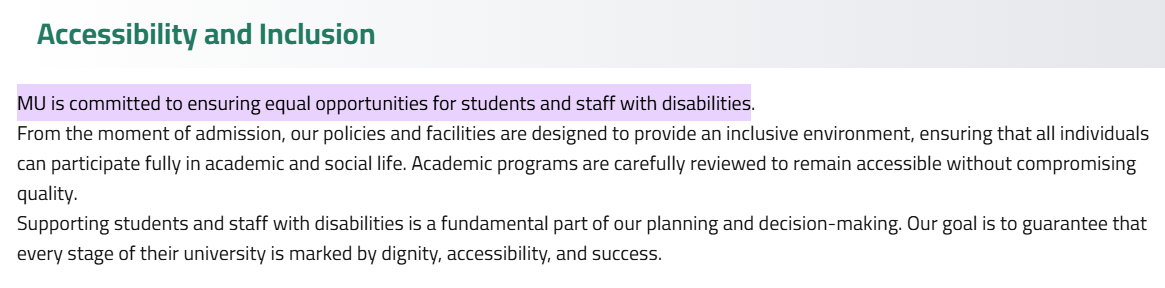
Furthermore, MU is inclusive of persons with disabilities, affirming that disability is never a barrier to accessing university activities. The university is “committed to ensuring equal opportunities for students and staff with disabilities”, and from the moment of admission, its policies and facilities are designed to provide an inclusive environment m.mu.edu.sa. Academic programs and campus services are continually reviewed to remain accessible without compromising quality, ensuring that individuals with physical or learning disabilities can participate fully in academic and social life. This demonstrates MU’s acceptance and accommodation of diverse needs – for example, providing wheelchair access, assistive technologies, or learning support as needed so that disabled students and employees can thrive. Supporting members of the university community with disabilities is described as “a fundamental part of [MU’s] planning and decision-making,” with the goal that every stage of a disabled student’s or staff member’s university experience is marked by dignity, accessibility, and success m.mu.edu.sa. By integrating disability inclusion into its equity policy, MU upholds diversity in the broadest sense, ensuring no one is excluded due to physical, sensory, or learning differences.
Equal Opportunity in Academic and Professional Activities
Majmaah University strives to provide equal opportunities across all areas of academic, professional, and campus life. This commitment spans training, research, community engagement (extension), employment, and administrative roles, so that no group is left out of any university activity. In practical terms, MU’s non-discrimination principles guarantee that admission to programs, participation in research projects, attendance at workshops or training sessions, and eligibility for jobs or promotions are based on merit and qualifications – never on personal attributes like ethnicity, gender, or religion mu.edu.sa. All students have the same access to high-quality education and co-curricular activities, and all staff have equal access to professional development opportunities. For instance, if the university offers research grants, leadership training, or internships, these are open to all eligible candidates without bias. This equitable approach ensures that everyone in the academic community can develop their skills and careers fairly.
One clear example is MU’s stance on gender equality in academia. As mentioned, female students are actively encouraged to enroll in various fields (including those where women have been historically underrepresented) and are given equal support and resources to excel. The university’s culture and policies emphasize that academic or professional achievement is judged by performance and talent, not by gender or any other personal factor mu.edu.sa. Similarly, hiring and promotion of faculty/staff are expected to follow equal opportunity principles – MU’s policy prohibits bias in employment, which helps ensure that women, minorities, and other underrepresented groups have fair chances in academic and administrative appointments mu.edu.sa. Indeed, having women in leadership positions at the university demonstrates its commitment to diversifying its workforce and governance, thereby providing inclusive role models for students mu.edu.sa.
The concept of “extension” or community engagement is also implemented equitably. MU often hosts public events, workshops, and community service programs and ensures these activities are accessible to all segments of society. As part of its social responsibility, the university makes a point to invite and include people of different backgrounds in public lectures, cultural events, and continuing education courses. This open access approach aligns with the idea that the university’s knowledge and resources should benefit everyone in the community, without discrimination. Internally, student clubs, sports, and campus facilities are open to all students (male and female, with or without disabilities), under policies that maintain inclusivity.
Moreover, equal opportunity at MU includes support for balancing work, family, and academic life. The university recognizes that providing equal access isn’t just about entry – it’s also about enabling people to stay and succeed in their roles as students or staff, regardless of personal life circumstances. To this end, MU has adopted measures to help members of its community harmonize their academic/professional responsibilities with family duties. For example, Majmaah University offers family-friendly policies such as maternity and paternity leave for its employees, in line with national labor regulations. Female employees are entitled to paid maternity leave (generally up to 10 weeks as per Saudi labor law), and fathers receive paternity leave as well, ensuring that new parents can attend to family needs without sacrificing their jobs m.mu.edu.sa m.mu.edu.sa. These leave policies support women’s continued participation in the workforce and allow both women and men to share childcare responsibilities, reflecting a commitment to gender equity in employment. Additionally, when women return to work after maternity leave, Saudi law (which MU follows) guarantees accommodations like breastfeeding breaks during work hours, and protection from job termination during maternity leave m.mu.edu.sa m.mu.edu.sa – all of which help create a supportive, family-conscious work environment.
Another significant initiative is the provision of on-campus childcare facilities to support student-parents and staff. Majmaah University has a nursery called “We Care” located close to campus, which is a valuable resource for parents pursuing their studies or working at the university. “We Care Nursery… provides accessible childcare facilities that enable [parents] to attend university courses without compromising their parenting responsibilities,” according to MU’s documentation m.mu.edu.sa. This nursery operates with extended hours (early morning until 7 PM) to accommodate class and work schedules, allowing parents – especially recent mothers – to balance their academic and professional commitments seamlessly m.mu.edu.sa. Importantly, “We Care Nursery extends its support by offering free childcare services exclusively to students and employees of Majmaah University,” relieving the financial burden of childcare for those parents m.mu.edu.sa. By prioritizing the needs of student and staff parents in this way, MU ensures that having a child does not hinder anyone’s ability to participate in university life. This initiative clearly illustrates MU’s dedication to equal opportunity: it recognizes that practical support (like childcare) is necessary to make access truly equal for those with family responsibilities. In summary, through such family-friendly policies and facilities, Majmaah University actively works to harmonize work, family, and academic life for its community members, so that everyone has an equitable chance to thrive academically and professionally.
Addressing Harassment and Gender-Based Violence
Majmaah University maintains a zero-tolerance stance toward harassment or gender-based violence, reinforcing its commitment to a safe and equitable environment for all. The university’s non-discrimination policy explicitly covers harassment as a prohibited behavior, defining it as any verbal, physical, or visual conduct based on protected characteristics that interferes with an individual’s work or study or creates an intimidating, hostile, or offensive environment mu.edu.sa. This means any harassment targeting someone’s gender, religion, ethnicity, disability, etc., is considered a form of discrimination and is strictly forbidden. All members of the MU community – students, staff, faculty, as well as visitors – are expected to refrain from such conduct. If anyone were to commit an act of gender-based violence or harassment in any university-related setting (whether on campus or during off-campus activities), it would be a direct violation of university policy.
Majmaah University has put in place measures for care, assistance, and accountability in cases of harassment or violence. According to the policy, “any member of the campus community, guest, or visitor who acts to deny, deprive, or limit the educational or employment opportunities of any other member based on protected characteristics is in violation of university policy.” Moreover, all university employees are mandated to report any suspected incidents of discrimination or harassment that they become aware of mu.edu.sa. When such a report is made, the university commits to addressing it: “When brought to the attention of the University, any such discrimination will be appropriately remedied by the University according to the procedures outlined in this policy.” mu.edu.sa. In practice, MU has a clear procedure for handling complaints, as noted earlier. Victims or witnesses of gender-based violence or any harassment can file a complaint or report, which will be investigated promptly and confidentially by the appropriate university authorities. The university’s goal is to ensure that acts of gender-based violence are dealt with through proper monitoring, support, and referral – this could include providing victims with counseling or medical assistance, taking disciplinary action against perpetrators, and involving law enforcement or external authorities when necessary (especially if the incident falls under criminal behavior). MU’s policies align with national laws such as the Saudi Law of Protection from Abuse, ensuring that the university cooperates with legal requirements to protect individuals from violence.
In terms of support and prevention, Majmaah University engages in education and outreach to combat gender-based violence and uphold human rights. For example, MU has hosted awareness seminars and campaigns on issues like violence against women. One such event, titled “No to Violence Against Women,” discussed how violence against women is a global phenomenon that “is one of the largest and most serious violations of human rights,” violating women’s rights to equality, dignity, and self-worth mu.edu.sa. The university’s female student affairs office has organized events for the International Day for the Elimination of Violence against Women, which included lectures on the legal aspects of gender-based violence, interactive presentations on domestic violence, and distribution of educational brochures mu.edu.sa mu.edu.sa. During these programs, MU officials emphasized a “commitment to women's rights guaranteed by Sharia and the [law]” and the need to fight all forms of violence against women mu.edu.sa. Through such initiatives, the university is actively raising awareness, training its community to recognize and report abuse, and affirming support for victims. MU also has a Guidance and Counseling Unit (as referenced in event descriptions) which likely provides assistance and referral for students who encounter harassment or violence. All these measures ensure that any act of gender-based violence is taken seriously and addressed with care and urgency. The overarching message is that Majmaah University does not tolerate harassment, bullying, or violence in any physical or virtual space related to the institution, and it stands ready to protect the rights and safety of its community members.
Commitment to Human Rights and Dignity
Underlying Majmaah University’s policies and actions is a strong commitment to human rights and equality. By ensuring inclusive access, embracing diversity, and safeguarding its members from discrimination or violence, MU is upholding fundamental human rights principles on campus. The university’s policies echo internationally recognized values – for instance, the right to education and work without discrimination, and the right to personal security and dignity. MU’s efforts also align with broader frameworks like Saudi Vision 2030 and the United Nations Sustainable Development Goals, which advocate for equality and the empowerment of women and minority groups mu.edu.sa. In promoting social justice and equal opportunity, the university contributes to positive social transformation in line with these global and national goals mu.edu.sa.
The Social Responsibility Observatory implements a lecture on social justice
https://www.mu.edu.sa/ar/news/centers-and-institutes/social-responsibility-obeservatory/178151
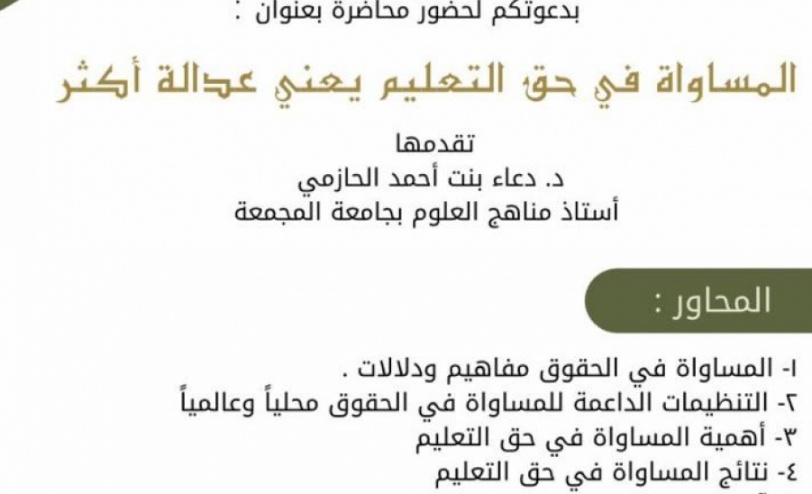
Within the framework of Majmaah University's efforts to promote social justice and positive social transformations and on the occasion of the World Day of Social Justice 2021, the Social Responsibility Observatory, in partnership with the Women's Committee for Community Development in Riyadh, held a lecture entitled: (Equality in the right to education means more justice), presented by Professor at the university, Dr. Doaa Al-Hazmi.
Where she discussed the concept of social justice, indicating that it is a system of policies and procedures that guarantee all people access to their rights in various fields with equality and equal opportunities for all, and the elimination of social and economic disparities.
Among the most important and prominent themes in the lecture were:
1- Equality in rights concepts and connotations that include the definitions, significance and concepts of equality.
2- Organizations supporting equal rights locally and globally, for example, plans and systems that support equal rights at the level of the Kingdom and globally, such as Vision 2030, and the United Nations Sustainable Development Goals 2030.
3- The importance of equality in the right to education.
4.The consequences of equality in the right to education and its importance lie in the consequences of achieving equality in access to education, the most important of which is the achievement of justice.
5- Proposed mechanisms to promote equal access to the right to education and the possibility of providing equal opportunities for all in the field of education.
In conclusion, Majmaah University, as an institution, clearly has policies and practices to ensure that access to all its activities is open to everyone – irrespective of ethnicity, religion, disability, gender, or other personal attributes. The university not only formally prohibits discrimination in its regulations mu.edu.sa, but also fosters a campus ethos of diversity, equity, and respect. It provides equal opportunities in education and employment for all members of its community, implements supportive measures to allow full participation (such as disability accommodations, parental leave, and childcare services), and has established mechanisms to prevent and address any form of harassment or rights violations. By respecting the human rights and dignity of every student and staff member, Majmaah University ensures that its environment is fair, inclusive, and conducive to the success of all.

شارك برأيك وساهم في تحسين خدماتنا.
أعجب 0 من 198 زائر بمحتوى الصفحة. (0% مؤشر رضا الزوار)